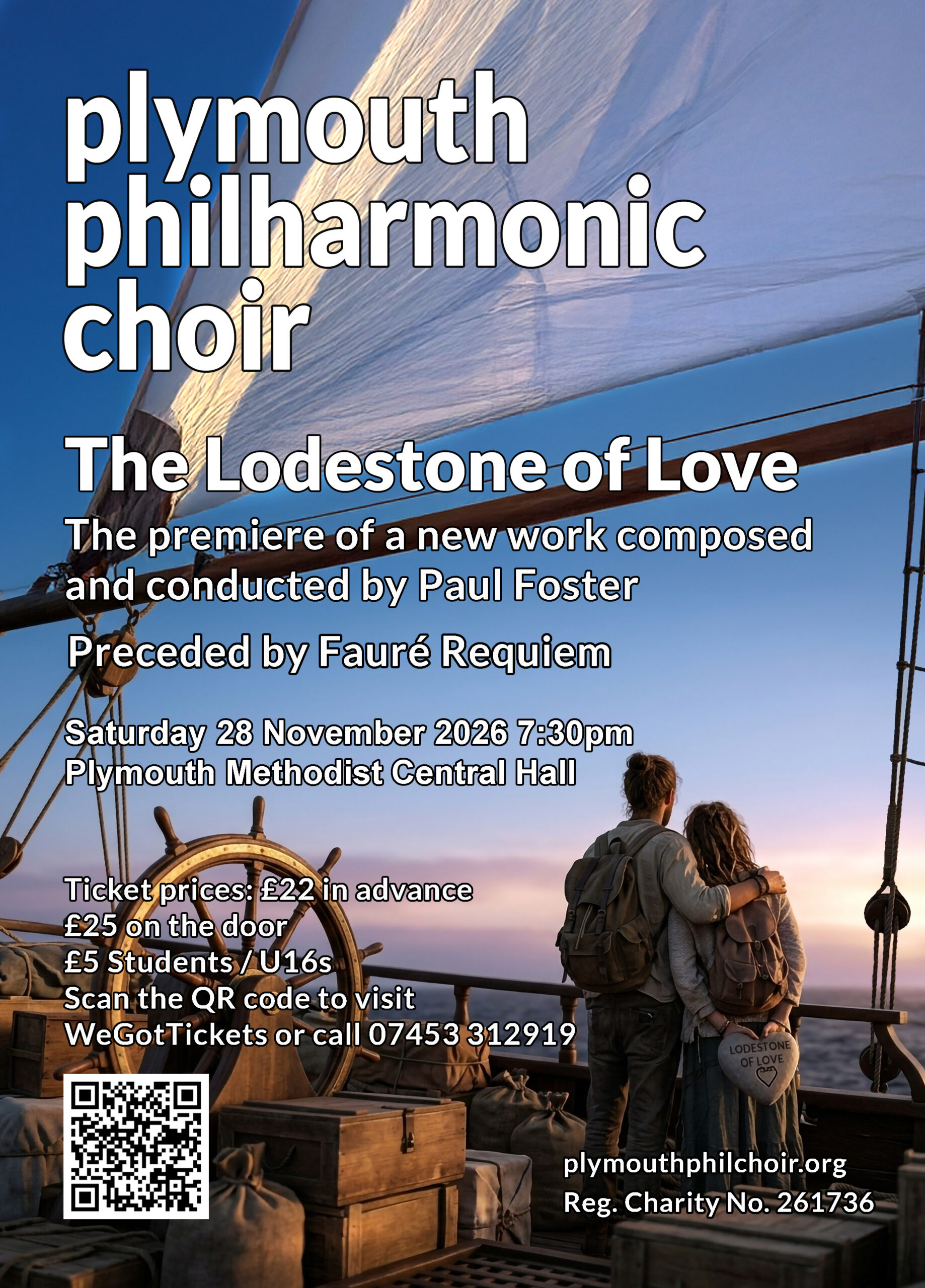
SATURDAY 28 November 2026
Lodestone of Love
The premiere of a new work written and conducted by Paul Foster
Together with Fauré Requiem
At Plymouth Methodist Central Hall 7:30pm

For tickets please call 07453 312919 or click this link:
https://wegottickets.com/f/22298

Lodestone of Love
The premiere of a new work written and conducted by Paul Foster

What happens when you realise that you have no choice but to reinvent yourself, to the point of leaving your old life behind and seeking new beginnings, and that you must begin a journey of transformation into the unknown?

Such brave choices are, of course, being replicated by groups and by individuals in the present day just as they have across the world throughout history.

The visceral themes of renunciation and renewal, fear and faith, hope and despair, hardship and good fortune that can accompany such a transformation are brought to life in a new work by Paul Foster set to premiere in November 2026 here in Plymouth.

Locally-born composer Paul Foster has created a colourful musical panorama that encompasses bustling docksides, scenes of farewell, love duets, seascapes, violent storms, a radiant sunset and sunrise, all bound together by the transformative power of love.

The work comprises dramatic multi-layered choruses, solos and duets, and vivid orchestration. The evocative text draws on moving writings of the seventeenth century puritans but their hopes, fears and sentiments for an ideal world transverse time, and resonate as much today as they did then.

This work commissioned by Plymouth Philharmonic Choir, was originally to celebrate Mayflower 400. Then COVID struck and performance was paused, until now. It is a work of eternal optimism and depicts the transformative power which love has to ensure that much ill fortune can ultimately be turned around.
Requiem in D minor Op. 48
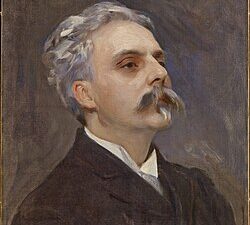
Gabriel Fauré (1845 – 1924)

Gabriel Fauré lived during a period of intense musical change; he was born at a time when European music was dominated by the great Germanic Romantic composers like R Schumann and Wagner but he died in a much more fractured musical landscape. As the director of the Paris Conservatoire from 1905-1914, Fauré  became one of the most important French composers and musicians of his generation. Through this position, he played a crucial role in revitalising and reforming French music, increasing the range of music taught at the Conservatoire and encouraging younger composers to embrace a French musical identity that went beyond that of earlier generations.

The Requiem is perhaps Fauré ’s best-known work and is a key piece in the choral canon. It has become especially popular in Britain, and several British conductors were among the first to promote Fauré ’s music in the early twentieth century, at a time when he was relatively unknown outside of France. Fauré  began work on the Requiem in 1888, and its first version consisted of just five movements: the Introit and Kyrie, Sanctus, Pie Jesu, Agnus Dei and In Paradisum. Later, in 1893, Fauré  expanded on this, adding the Offertory and Libera Me movements. A third version of the Requiem was subsequently published in 1900 with full orchestration. This is not a Requiem in the mould of Berlioz’s huge ‘Grande Messe des Mortes’ or Verdi’s grandly operatic Requiem. Instead, the whole piece is a much more intimate affair; indeed, Fauré  omits the Dies Irae entirely from the Requiem, choosing instead to include the much more contemplative In Paradisum text.

While much of the Requiem is in this more contemplative mould, it is certainly not without moments of drama and deep emotion. One such moment comes in the Agnus Dei where, after the music seemingly comes to a halt, the choir quickly builds to a huge climax before we arrive at a restatement of the music that opens the Requiem. Another even more potent moment comes in the Libera Me. Here, following the opening baritone solo and a timid entry to the choir, Fauré  suddenly speeds everything up and asks the choir to sing consistently fortissimo (very loud) for the words “Dies Illa, dies irae, calamitatis et miseriae – ‘that day, the day of anger calamity and misery’.

Programme notes provided courtesy of Samuel Huston

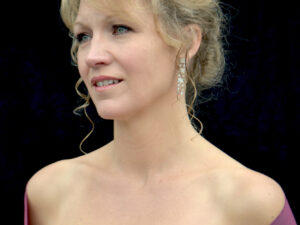
Soprano: Catherine Hamilton

Catherine was the first singer to be awarded a Junior Exhibitioner’s scholarship in the history of the Royal Academy of Music at the age of ten. After gaining a BA Hons from Southampton University she returned to the RAM on the post-graduate opera course and was awarded the Diploma of Advanced Studies and a LRAM with Distinction. During her time there she was chosen as the soloist for an official recording for HRH Prince William.

Catherine is a versatile performer whose international career has encompassed opera, oratorio, recitals, and musical theatre. She made her West End debut at The Queen’s Theatre with the acclaimed production of Masterclass and toured Germany as Christine in “Das Phantom der Oper”. Her many operatic roles have taken her throughout Europe and closer to home for Opera Holland Park’s summer season and Devon Opera.

Catherine is in great demand as an oratorio soloist and has sung extensively for choirs and choral societies across Europe in major venues. Highlights have included Mozart’s Exsultate Jubilate at the Festival Saint- Eloi in France and a concert tour in Italy, culminating in a performance in St. Peter’s Rome.

Among her performances as a recitalist was a concert series of Rodrigo’s songs for the Spanish ambassador at their Institute in London and a recording of Bachianas Brasileiras no 5 by Villa Lobos. Catherine was also chosen as the soloist for the regional premier of “The Great War Symphony” by Patrick Hawes.

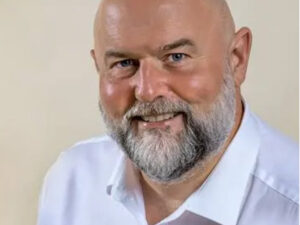
Baritone/Bass: Darren Jeffrey

Darren Jeffery is as much in demand on the operatic stage as he is on the concert platform. Darren studied at the Royal Northern College of Music in Manchester with Patrick McGuigan.  He received the RNCM’s highest accolade, the Curtis Gold Medal and performed the title role in its award-winning production of Verdi’s Falstaff.  From 2001-2003 he was an inaugural member of the Royal Opera Young Artists Programme.

Darren has made over two hundred appearances at the Royal Opera, Covent Garden and has become well known for his performances at English National Opera. A firm favourite as a soloist in Oratorio and Concert, Darren has collaborated with several of the world’s leading conductors and orchestras.  He has appeared at the Salzburg and Aix-en-Provence festivals and with most of the UK’s festivals. He gave a series of recitals in Victoria, Australia entitled ‘The Wanderer’ as part of a new Wagner festival.

Concert appearances include Christus in Bach’s St. Matthew Passion with Sir Mark Elder and the Hallé Orchestra, the BBC Proms (Elijah, Le Rossignol, Les Troyens, Serenade to Music, Peter Grimes, Billy Budd, Haydn’s Seven Last Words from the Cross) and the major choral works of Bach, Beethoven, Brahms, Elgar, Handel, Haydn, Mendelssohn, Mozart and Verdi, among others.

He has appeared on several occasions with the Accademia Nazionale di Santa Cecilia in Rome and collaborated with many of the world’s leading conductors and orchestras. He has also contributed to recordings, two of which, with the London Symphony Orchestra, won Grammy awards.

Recordings include Fidelio, Benvenuto Cellini, Mozart Requiem and the Grammy winning Falstaff / Sir Colin Davis and Billy Budd / Daniel Harding, all with the London Symphony Orchestra.

Darren Jeffery appears by agreement with Grove Artists www.grovesartists.com

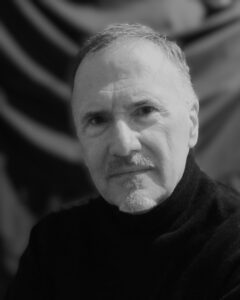
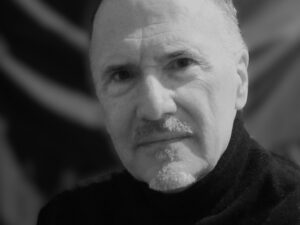
Dr Paul Foster

Paul studied piano, voice, conducting and composition at the University of London (Master of Music) and vocal studies at the London Guildhall School of Music and Drama.  He has a PhD in Music Composition from the University of Manchester and has been a visiting professor at the University of St Mark & St John.

He worked in London for many years in a wide range of music, covering music theatre, orchestral, symphonic wind orchestra and opera repertoire, and on projects with the Royal Opera House and London Sinfonietta, ranging from accompanying West End stars in recital to playing piano on the South Bank for the Sir Peter Maxwell Davies birthday celebrations. By contrast, his first experience of a recording studio was with Manfred Mann’s Earthband.

Returning to his native South-West, he has conducted almost one hundred performances at the Theatre Royal in Plymouth and has been conductor for award-winning performances with New Devon Opera and Plymouth G&S Theatre Company, holding the title of conductor emeritus with the latter.  He regularly guests for orchestras and choirs across the region as a continuo player in oratorios.

On the educational side of his career, Paul has been Music Advisor for the largest of the London boroughs, an Ofsted inspector (shh!) and has trained around five thousand new primary and secondary teachers to teach music as part of their initial teacher training.

As well as working as a composer, conductor, pianist and university lecturer, he is an award-winning actor and published poet.  He won a national award for his portrayal of the title role in ‘Amadeus’ in Greenwich – a version of Mozart’s persona that he does not seek to emulate when conducting that composer’s works!

Performances of Paul’s compositions have included the South Bank and abroad, and his works have been selected for the annual shortlist of the Society for the Promotion of New Music.  One of his latest pieces, a large-scale oratorio called ‘The Lodestone of Love’, was commissioned by Plymouth Philharmonic Choir for the Mayflower 400 celebrations, delayed due to Covid restrictions, but which will be premiered in the Plymouth Methodist Central Hall in November 2026.