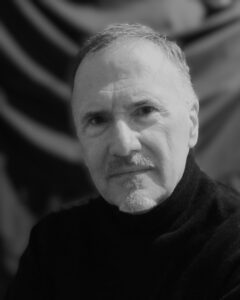
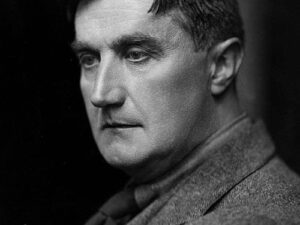
 Ralph Vaughan Williams Five Mystical Songs
English composer Vaughan Williams (1872-1958) prolific works include operas, ballets, chamber music, secular and religious vocal pieces and orchestral compositions including nine symphonies, written over sixty years.
Vaughan Williams was born to a well-to-do family with strong moral views and a progressive social outlook. Throughout his life he sought to be of service to his fellow citizens, and believed in making music as available as possible to everybody. He wrote many works for amateur and student performance. He was musically a late developer, not finding his true voice until his late thirties; his studies in 1907–1908 with the French composer Maurice Ravel helped him clarify the textures of his music and free him from previous Germanic influences. Ravel took few pupils and was known as a demanding taskmaster for those he agreed to teach. This period is thought to have had a strong influence on Vaughan Williams’ later repertoire.
Vaughan Williams is among the best-known of British symphonists, noted for his portrayal of a very wide range of moods, from stormy and impassioned to tranquil, from mysterious to exuberant. Among the most familiar of his other works are Fantasia on a Theme by Thomas Tallis (1910) and The Lark Ascending (1914). His vocal works include hymns, folk-song arrangements and large-scale choral pieces. He wrote eight works for stage performance between 1919 and 1951. Although none of his operas became popular repertoire pieces, his ballet Job: A Masque for Dancing (1930) was successful and has been frequently staged.
Two episodes made notably deep impressions in Vaughan Williams’s personal life. The First World War, in which he served in the army, had a lasting emotional impact. Twenty years later, though in his sixties and devotedly married, he was reinvigorated by a love affair with a much younger woman, who later became his second wife. He went on composing throughout his 70’s and 80’s, producing his last symphony only months before his death at the age of 85. His works have continued to be a staple of the British concert repertoire.
Five Mystical Songs (1911)
These five songs, settings of poems by the 17th-century poet and Anglican priest George Herbert (1593-1633), were completed in 1911 and first performed at the Three Choirs Festival in Worcester in September of that year. While Herbert was a priest, Vaughan Williams himself was an atheist at the time of the composition, though this did not prevent his setting of verse of an overtly religious inspiration.
Like Herbert’s simple verse, the songs have the same intrinsic spirituality as the original text. They were supposed to be performed together, as a single work, but the styles of each vary quite significantly. The first four songs are quiet personal meditations in which the soloist takes a key role, particularly in the third – Love Bade Me Welcome, where the chorus has a wholly supporting role (quietly and wordlessly singing the plainsong melody O Sacrum Convivium), and the fourth, The Call, in which the chorus does not feature at all. The final “Antiphon” is probably the most different of all: a triumphant hymn of praise sung either by the chorus alone or by the soloist alone. It is also sometimes performed on its own, as a church anthem for choir and organ: “Let all the world in every corner sing”.
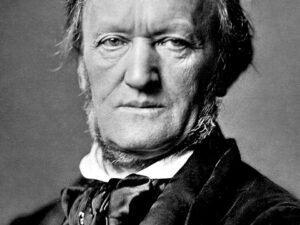
Wilhelm Richard Wagner (1813–1883)
Wagner was a German composer, conductor and theatre director who was primarily known for his operas. The greatest musical visionary of the 19th century, or an insatiable megalomaniac who didn’t know when to stop – opinions vary but it is certainly the case that people react strongly to his music.
Wilhelm Richard Wagner was born in 1813 in the Jewish quarter of Leipzig. As a boy, he showed little aptitude for music and he was the only child in his family not to receive piano lessons – he later taught himself to play through Weber’s Der Freischutz.
At the age of 20, Wagner took a choirmaster position in Würzberg and composed his first opera, Die Feen, in 1833. His opera career soon picked up speed – he completed Rienzi in 1840, The Flying Dutchman in 1843 and Tannhauser in 1845.
Wagner’s most enduring work, Der Rin des Nibelungen (The Ring of the Nibelung, or the Ring Cycle), consists of four separate operas and took 26 years to complete. He finally reached the conclusion, Götterdämmerung, in 1876. Written in 1859, Tristan und Isolde is another example of Wagner’s operatic ideal of what he called the Gesamtkunstwerk (‘Complete Art-Work’). Die Meistersinger von Nürnberg from 1868 might not match The Ring Cycle for length, but it’s still a hefty four-and-a-half hours long. Wagner’s last completed opera was Parsifal from 1882, a typically epic work that told the story an Arthurian knight on the hunt for the Holy Grail. Even though Wagner’s music was controversial it was not as extreme as his anti-semitic declarations, found most famously in his article Das Judenthum in der Musik (Judaism in Music), which notoriously led directly to Hitler’s passionate espousal of his music.
Wagner died in 1883 after suffering a heart attack on holiday in Venice.
Wagner’s masterpiece remains The Ring Cycle, which is made up of four different operas and takes more than fifteen hours to perform.
Siegfried Idyll (1870)
The general public was never meant to hear Richard Wagner’s Siegfried Idyll, it was a very private work.
Cosima Wagner, the composer’s wife (and the daughter of Franz Liszt), celebrated her 33rd birthday on Christmas Day 1870. She awoke to a 15-piece orchestra playing this piece on the staircase leading up to her room.
It was Richard’s way of thanking her for their marriage four months earlier (though they had been together since 1864) and for the birth of their first son, Siegfried, who was by now 18 months old.
The family named it Tribschen Idyll after their country retreat near Geneva, and it was performed each year for Cosima regarded as Richard’s statement of love for her. The Idyll would have remained entirely within the family had not financial pressures forced Wagner to seek publication in 1877.
The Siegfried title came into being at about this time and Wagner provided a sub-title “a Symphonic birthday greeting”.
It is the most played of Wagner’s instrumental works, a work of delicacy and emotion and contains a theme from act III of Wagner’s opera Siegfried complemented by a lullaby composed, presumably for his son, by Wagner in 1868.
The work is scored for a small orchestra (they had to stand on the staircases after all) but is commonly performed by a standard orchestra today.
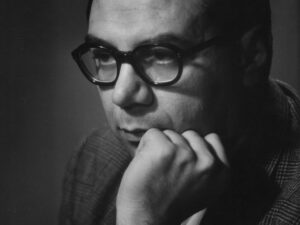
Aerial Ramirez (1921-2010) Misa Criolla
Ariel Ramírez was an Argentine composer, pianist and music director. He was considered a chief exponent of Argentine folk music and celebrated for his iconic musical compositions.
Ramírez is known primarily for his Misa Criolla (1964). This work allowed him to travel around Europe and Latin America to build his reputation. He wrote more than 300 compositions during his career, however, and sold over 10 million albums.
Ariel Ramírez was born in Santa Fe, Argentina. His father, who was from Spain and had immigrated to Argentina, was a teacher and it had been thought Ramírez would also pursue this career path but it was not to be.
He pursued an artistic career initially as a dancer before switching to Argentine folklore. He began his piano studies in Santa Fe, and soon became fascinated with the music of the gauchos and creoles in the mountains. He continued his studies in Córdoba, where he met the great Argentine folk singer and songwriter Atahualpa Yupanqui and was influenced by him.
Ramírez went on to study classical music in Madrid, Rome and Vienna. Back in Argentina, he collected over 400 folk and country songs and popular songs and founded the Compañía de Folklore Ariel Ramírez.
Misa Criolla was one of the first masses not in Latin completed shortly after the Second Vatican Council permitted use of the vernacular in Catholic churches.
The Washington Post wrote that the Misa Criolla is “widely regarded as a stunning artistic achievement,that combined Spanish text with indigenous instruments and rhythms”. It led to album sales numbering in the millions internationally.
Ramírez once told The Jerusalem Post how Misa Criolla was inspired by a visit to Germany after World War II. While there, he had an encounter with two of 5 sisters (siblings, not nuns), who had regularly risked their lives bringing food to prisoners of the Nazis in their neighbourhood, which led him to consider writing “a spiritual piece”. This would eventually become the Misa Criolla.
The Misa is a 16-minute Mass for either male or female soloists, chorus, and traditional instruments and is based on folk genres such as chacarera, carnavalito, and estilo pampeano, with Andean influences and instruments.
Ramírez wrote the piece between 1963 and1964, and it was recorded in 1965. by Philips Records, directed by Ramírez himself with Los Fronterizos as featured performers. It was not publicly performed until 1967 in Düsseldorf, Germany, during a European tour that eventually brought Ariel Ramírez before Pope Paul VI.
Other notable recordings feature the solo voices of George Dalaras (1989), José Carreras (1990), and Mercedes Sosa (1999). Plácido Domingo recorded the Kyrie (the first movement of the Misa) with Dominic Miller on guitar (2003).
On 12 December 2014, the feast of Our Lady of Guadalupe, it was performed in St. Peter’s Basilica, Rome at the invitation of Pope Francis, with Patricia Sosa as the soprano soloist and conducted by Facundo Ramírez, son of the work’s composer, who had conducted its first performance in St. Peter’s Basilica exactly fifty years earlier.
 Antonio Vivaldi (1678–1741)
Antonio Vivaldi was one of the most productive composers of the Baroque era. His vast output included substantial quantities of chamber and vocal music, some 46 operas and a remarkable 500 concertos.
A colourful character with an eye for the ladies, Vivaldi defied a lifetime of ill-health by regularly absenting himself from his home base of Venice in a desperate attempt to establish an international reputation.
The exact date of Vivaldi’s birth (4th March 1678) confounded scholars for many years, although it was known that following his delivery the midwife performed an emergency baptism. The reason for his emergency baptism is not known for certain but is likely due to his poor health or to an earthquake that shook Venice on that day.
Vivaldi’s father, Giovanni Battista, was a violinist at St Mark’s Cathedral, and although he taught the prodigiously gifted Antonio to play from early childhood, a musical career seemed unlikely, especially when, aged 15, he was sent off to join the priesthood. He studied at the seminary for 10 years, received Holy Orders in 1703 and earned the nickname “il prete rosso” (the red priest) from the distinctive colour of his hair.
By September 1703 Vivaldi had secured his first professional appointment as violin master at the Pio Ospedale della Pieta, one of four orphanages for girls in Venice. Remarkably, this was to remain his base for the greater part of his life, from 1703 to 1740, though with several prolonged ‘leaves of absence’.
Throughout the 1730s Vivaldi travelled widely – to Bohemia, Austria and throughout Italy – despite the fact that his worsening health meant taking an expensive entourage of carers. Destitute and alone, he passed away in Vienna in 1741 and was buried cheaply the same day in a hospital cemetery which sadly no longer exists.
Gloria in D
Vivaldi composed this Gloria in Venice, probably in 1715, for the choir of the Ospedale della Pietà, an orphanage for girls (or more probably a home, generously endowed by the girls’ ‘anonymous’ fathers, for the illegitimate daughters of Venetian noblemen and their mistresses). The Ospedale prided itself on the quality of its musical education and the excellence of its choir and orchestra.
Vivaldi, a priest, music teacher, composed many sacred works for the Ospedale, where he spent most of his career, as well as hundreds of instrumental concertos to be played by the girls’ orchestra. This, his most famous choral piece, presents the traditional Gloria from the Latin Mass in twelve varied cantata-like sections.
The wonderfully sunny nature of the Gloria, with its distinctive melodies and rhythms, is characteristic of all of Vivaldi’s music, giving it an immediate and universal appeal.
The opening movement is a joyous chorus, with trumpet and oboe obbligato. The choir enters in chorale-like fashion, declaiming the text in regular rhythms, contrasting with the orchestral accompaniment, which contains most of the melodic interest of the movement.
The second movement in B minor ‘Et in terra pax’ is in nearly every way a contrast to the first. It is in triple rather than duple time, in a minor key, and rather slower.
Laudamus te’, a lively duet for the two soprano soloists, gives us some hint of the skill of Vivaldi’s young singers. ‘Gratias agimus tibi’ acts as a prelude to a fugal allegro on ‘Propter magnam gloriam’.
The Largo ‘Domine Deus, Rex coelestis’ is in the form of a duet between the solo soprano and the solo violin, followed by the joyful F major ‘Domine Fili unigenite’ chorus in what Vivaldi and his contemporaries would have regarded as the ‘French style’. It is dominated by the dotted rhythms characteristic of a French overture.
‘Domine Deus, Agnus Dei’ features the alto soloist, with the chorus providing an antiphonal response, ‘qui tollis peccata mundi’, to each intercession.
The bold harmonies of the following section, ‘Qui tollis’, provide a refreshing change of tone colour, and complement the intercessional alto aria, ‘Qui sedes ad dexteram Patris’. The string accompaniment contains recollections of the opening movement, and prepares for the following movement, ‘Quoniam tu solus sanctus’, which takes the shape of a brief reprise of the opening movement’s broken octaves.
The powerful ‘stile antico’ double fugue on ‘Cum Sancto Spiritu’ that ends the work is an arrangement by Vivaldi of the ending of a Gloria per due chori composed in 1708 by an older contemporary, the now largely forgotten Veronese composer Giovanni Maria Ruggieri.
Today Vivaldi is one of the most popular of all composers, who during his lifetime enjoyed considerable success and fortune, which he squandered through extravagance, and when he died in Vienna he was buried in a pauper’s grave. For two centuries after his death, the Gloria lay undiscovered until the late 1920s, when it was found buried among a pile of forgotten Vivaldi manuscripts.
It was not until 1957 that the now familiar original version was published and given its first performance at the First Festival of Baroque Choral Music at Brooklyn College, NY.