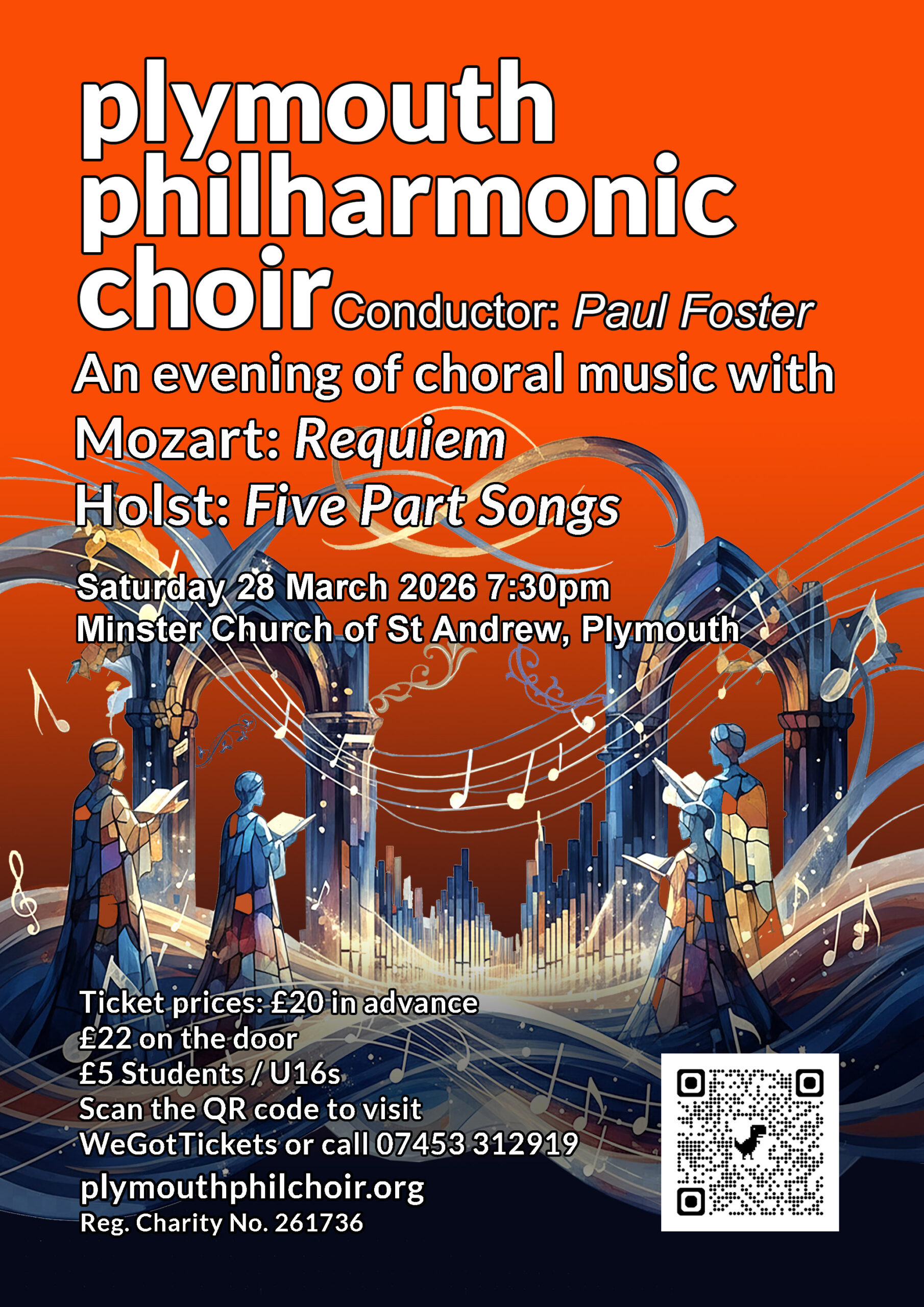
SATURDAY 28 MARCH 2026
Mozart Requiem
Mozart Exsultate Jubilate (Soprano soloist)
Holst Part Songs Opus 12 & I Love My Love Opus 36B
Holst St Paul’s Suite (instrumental)

At the Minster Church of St Andrew, Plymouth Saturday 28 March at 7:30pm

For tickets the Book Online button will operate for this concert from December.
In the meantime you can call 07453 312919 or click this link:
https://wegottickets.com/event/681844

Wolfgang Amadeus Mozart
Requiem
Exsultate Jubilate (Soprano soloist)

A prolific artist, Austrian composer Wolfgang Amadeus Mozart created a string of operas, concertos, symphonies and sonatas that profoundly shaped classical music.

Mozart was a musician capable of playing multiple instruments who started playing in public at the age of 6. Over the years, Mozart aligned himself with a variety of European venues and patrons, composing hundreds of works that included sonatas, symphonies, masses, chamber music, concertos and operas, marked by vivid emotion and sophisticated textures.

Born in 1756, in Salzburg, Austria, Mozart is widely recognized as one of the greatest composers in the history of Western music. With Haydn and Beethoven he brought to its height the achievement of the Viennese Classical school. Unlike any other composer in musical history, he wrote in all the musical genres of his day and excelled in every one. His taste, his command of form, and his range of expression have made him seem the most universal of all composers.

Mozart’s death in 1791, however, came at a young age, even for the time. At the time of his death, though, Mozart was considered one of the greatest composers of all time. His works remained secure and popular throughout the 19th century, as biographies about him were written and his music enjoyed constant performances and renditions by other musicians. His work influenced many composers that followed – most notably Beethoven.

His music continues to be celebrated and is considered, alongside the works of his friend Joseph Haydn, a pinnacle of the symphonic, chamber, operatic, and choral repertoires. He is still widely studied and performed today.

Mozart composed Exsultate, jubilate, his best known solo motet, for the famous soprano castrato Venanzio Rauzzini.  Rauzzini (1746-1810) was born near Rome, became a principal at the opera in Vienna and served at the court in Bavaria.

Mozart had come to know him at the end of 1772 in Milan, when the ducal court in that city hired Rauzzini to sing in the premiere of the young Mozart’s opera Lucio Silla.  Mozart, who admired Rauzzini’s singing, wrote the virtuosic Exsultate, jubilate for him a month later. The work premiered in a Milan church on January 17,1773, whilst the production of Lucio Silla was still running.

In the following year,1777, Rauzzini moved permanently to England and established himself in Bath, where he lived for the remainder of his life.  There he directed a concert series, sang, composed a great deal of music, and became the esteemed teacher of many fine singers, many of whom later worked with Mozart in Vienna.

Mozart’s Requiem in D minor is considered a profound and unfinished masterpiece that reflects both the composer’s genius and the circumstances of its creation.

Mozart composed the Requiem in late 1791, during a time when he was facing significant personal and health challenges. He was commissioned by Count Franz von Walsegg to create the piece in memory of the Count’s wife, who had died earlier that year. Mozart passed away on December 5, 1791, before he could complete the work.
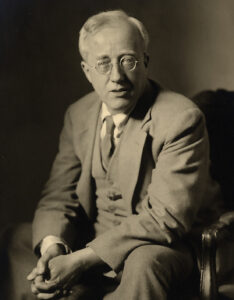
Gustav Holst
Part Songs Opus 12 & I Love My Love Opus 36B
St Paul’s Suite (instrumental)

Gustav Holst (1874-1934) was an English composer and music teacher, best known for his orchestral suite “The Planets,” which has become a staple of classical music.

Holst was born in Cheltenham in 1874, into a family of Latvian-Russian origin with a strong musical tradition, with professional musicians in three generations of the family. His father was a professional musician, which greatly influenced his interest in music.  

Holst’s father taught him the piano, violin and trombone, and the young musician went on to study with Stanford at the Royal College of Music from 1893 to 1898. But even when young he began to be troubled by neuritis in his right arm, which curtailed his keyboard skills.

He was not well-off, unlike so many of his musical contemporaries, and he first earned his living as a professional trombone player, touring with the Carl Rosa Opera Company and later joining the Scottish Orchestra. This was of enormous value to him as a composer, as he gained a practical understanding of the orchestra from the inside, experience which characterized his flair and brilliance for orchestral writing throughout his life.

Gustav Holst’s Five Partsongs, Op. 12 are early choral works by Holst written around 1902–1903. While less famous than his later suites, these pieces showcase his early development of choral texture and melody.

The set consists of five songs composed for mixed choir (SATB):

  1. Dream Tryst (Text by Francis Thompson) – A lyrical, atmospheric piece
  2. Ye Little Birds (Text by Thomas Heywood) – A light, expressive setting originally for four voices.
  3. Her Eyes the Glow-worm Lend Thee (Text by Robert Herrick) – Notable for its rhythmic vitality and playfulness.
  4. Now is the Month of Maying (Text: Anonymous) – Not to be confused with the Morley madrigal, this is Holst’s own original setting.
  5. Come to Me (Text by Christina Rossetti) – A deeply emotive and romantic piece

Gustav Holst’s “I Love My Love”  is a Cornish folk song arrangement for mixed voices (SATB) published around 1916. It tells a dramatic, bittersweet tale of a woman sent to a Bedlam, or mental hospital, due to her lover being sent away to sea, yet it ends happily when he returns from sea to marry her.

Key details about the piece:

  • Theme: The lyrics center on a woman’s devotion, featuring the refrain: “I love my love because I know my love loves me!”.
  • Origin: Collected by George Gardiner, this traditional Cornish song was arranged by Holst, with the melody also appearing in his Second Suite for Military Band

For this concert the work has been set to a new orchestration by the choir’s Musical Director Paul Foster.

St Paul’s Suite is a popular work for string orchestra.

Finished in 1913, but published later, in 1922, it takes its name from St Paul’s Girls’ School in Hammersmith, London. Holst served as the school’s music master from 1905 to 1934 and was grateful to the school for building a soundproof studio for him.

The suite is one of many pieces he wrote for the school’s students.The piece is made up of four movements:

  1. Jig: Vivace
  2. Ostinato: Presto
  3. Intermezzo: Andante con moto
  4. Finale (The Dargason): Allegro

The Finale was arranged from the “Fantasia on the Dargason” from Holst’s Second Suite in F for Military Band. The folk song “Dargason” is heard in the soft introduction. “Dargason” is then followed by “Greensleeves” played in the cellos. The two folk songs are then played together until the end of the movement.

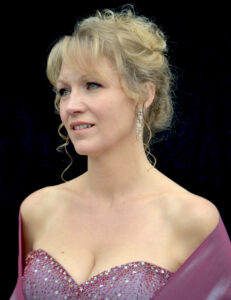
Catherine Hamilton – soprano
Catherine was the first singer to be awarded a Junior Exhibitioner’s scholarship in the history of the Royal Academy of Music at the age of ten. After gaining a BA Hons from Southampton University she returned to the RAM on the post-graduate opera course and was awarded the Diploma of Advanced Studies and a LRAM with Distinction. During her time there she was chosen as the soloist for an official recording for HRH Prince William.

Catherine is a versatile performer whose international career has encompassed opera, oratorio, recitals, and musical theatre. She made her West End debut at The Queen’s Theatre with the acclaimed production of Masterclass and toured Germany as Christine in “Das Phantom der Oper”. Her many operatic roles have taken her throughout Europe and closer to home for Opera Holland Park’s summer season and Devon Opera.

Catherine is in great demand as an oratorio soloist and has sung extensively for choirs and choral societies across Europe in major venues.

Highlights have included Mozart’s Exultate Jubilate at the Festival Saint- Eloi in France and a concert tour in Italy, culminating in a performance in St. Peter’s Rome.

Among her performances as a recitalist was a concert series of Rodrigo’s songs for the Spanish ambassador at their Institute in London and a recording of Bachianas Brasileiras no 5 by Villa Lobos. Catherine was also chosen as the soloist for the regional premier of “The Great War Symphony” by Patrick Hawes.

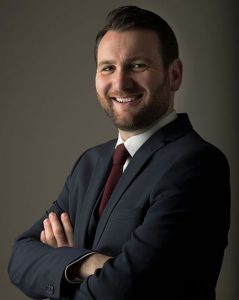
Robyn Lyn Evans – tenor
Robyn is from Ceredigion in mid Wales and is a postgraduate of the Royal College of Music, a graduate of Trinity College Carmarthen, and recipient of the Stuart Burrows Bursary.

His operatic roles include Rodolfo La bohème (English National Opera, Mid Wales Opera, Diva Opera); Don José, Carmen, Alfredo La traviata and Macduff Macbeth (Scottish Opera); Lord Cecil and Roberto Devereux, Ismaele Nabucco, Lord Hervey Anna Bolena (Welsh National Opera); Malcolm Macbeth (Opera North); Don Ottavio Don Giovanni and Rodolfo La bohème (English Touring Opera); Pinkerton Madama Butterfly and Ruggero La rondine (West Green House Opera); Lensky Eugene Onegin, Luigi Il tabarro (Mid Wales Opera); Duke of Mantua Rigoletto (Opera Project, Longborough Festival Opera); Cavaradossi Tosca, Rinuccio Gianni Schicchi and Fenton Falstaff (Opera Project); Nemorino L’elisir d’amore; and Alfred Die Fledermaus (Pavilion Opera).

Robyn can be frequently heard on the concert platform with countless performances from the oratorio repertoire and appearances which have taken him to the Royal Albert Hall, Royal Philharmonic Hall Liverpool, Usher Hall Edinburgh, St David’s Hall Cardiff, as well as guest soloist with choirs touring Europe.

Clare McCaldin – mezzo-soprano
Clare began her singing life as a choral scholar at Clare College, Cambridge. Described by The Independent as “an outstanding singing-actress”, she brings charm, charisma and passion to her live performances.

In oratorio she has performed with the Academy of Ancient Music/King’s College, Cambridge (Bach B Minor Mass), The Three Choirs Festival (Mozart Requiem, Handel Messiah), Barokksolistene (Bach, St Mark Passion), the Orchestra of the Golden Age (Messiah), the Northern Sinfonia (Bach, B Minor Mass), Harrogate Choral Society (Rossini Stabat Mater), Ryedale Festival and St Albans Bach Choir (Rossini, Petite Messe Solennelle). She made her solo debut at the 2012 BBC Proms in Debussy’s The Martyrdom of St Sebastian with the BBCSO, which also opened the 2014 Edinburgh International Festival.

Clare is in demand as an ensemble musician, working with artists such as Libby Burgess, Iain Burnside, Simon Lepper, Andrew West, the Brodsky Quartet and Berkeley Ensemble. She has appeared in recitals at the Royal Opera House, Ludlow English Song Weekend, Oxford Lieder and Presteigne Festival.

Clare has recorded songs by Hugh Wood (NMC) and Ned Rorem (Champs Hill Records) as well as a significant body of mezzo-soprano repertoire written especially for her, notably Stephen McNeff’s Madrigali dell’Estate and Vivienne. She has also recorded the role of Miss Tina in Michael Hurd’s The Aspern Papers (Lyrita) and Mrs Fairfax/Hannah in John Joubert’s Jane Eyre (Somm).

Clare has sung as a soloist with Sir Antonio Pappano, Vladimir Jurowski and Esa Pekka-Salonen. Her operatic roles include Fox The Cunning Little Vixen/Örsze Hary Janos (Ryedale Festival) Meg Page Falstaff (Iford Arts), Oreste La Belle Helene (Diva Opera),  In contemporary opera, Clare has appeared as the Stardust Seller (The Gentle Giant, ROH Linbury), the Mezzo Actor (A Night at the Chinese Opera, Scottish Opera) and Mezzo Cautioner (Cautionary Tales, Opera North), as well as works in development at ROH, Opera North, WNO and Aldeburgh Music. Clare’s one-woman operas Vivienne (2013) and Mary’s Hand (2018) were reviewed with ✮✮✮✮✮ by the Evening Standard and Independent respectively.

Robert Rice – baritone
My interests as a musician have led me to some extraordinary places and I hope to share some of my performing experiences with you on these pages, as well as giving news of forthcoming concerts and opera performances.

I am a Londoner, and apart from studying in Cambridge I have always lived in London, so when Opera Circus invited me to tour Bosnia with a new opera by Nigel Osborne in 2007 I jumped at the chance to explore this cultural watershed of a country; you can read my blog about it, fresh even for my calm demeanour – singing unfamiliar Shostakovich from the pit, and recording Elgar at three hours’ notice, for a start – there is always something positive to take from them.

I firmly believe in the power of music as a connecting force for the good of the whole community, not merely as entertainment, and that’s why I have always been pleased to be involved with workshops, coaching, and teaching other singers, and in arranging vocal music, and I hope that my career will always allow me those opportunities.

After a choral scholarship at King’s College, Cambridge, British baritone Robert Rice gained a DipRAM in London under Mark Wildman, continuing his studies with Richard Smart, Sheila Barnes and Nicholas Powell. As a concert artist his repertoire is extensive and varied: in 2015 he has premiered Andrew Edwards’ Christmas Story, Jacques Cohen’s Exodus Fragment, and Paul Drayton’s St Mark Passion, in addition to familiar works such as Bach’s St John and St Matthew Passions, and Mozart’s Requiem. His future plans include Monteverdi’s Vespers for the Royal Choral Society in London, and the premiere of Philip Cooke’s Noah’s Fire in Chester Cathedral. His interest in performing contemporary music encompasses the modernist expressionism of Peter Maxwell Davies and Ligeti, and staged premieres by Judith Bingham and Nigel Osborne (with Opera Circus, touring the UK and Bosnia & Herzegovina); more recently he covered two roles in Birtwistle’s Yan Tan Tethera for the Britten Sinfonia. In recital he often collaborates with guitarist Erich Schachtner in Germany and in the UK on programmes of lieder and lute songs.

Robert has recorded Judas in The Apostles with Canterbury Choral Society and the Philharmonia Orchestra, and his version of Cornelius’ Die Drei Könige (The Three Kings) with the choir Polyphony is a favourite on both Classic FM and BBC Radio 3 whenever Christmas approaches. When not performing, he leads workshops, adjudicates, and teaches widely, including for the National Youth Choir, Eton Choral Courses, and Oxford and Cambridge Universities. Novello & Co. Ltd have published many of his vocal arrangements, while others are sung worldwide, and have been recorded, by the King’s Singers. His nickname Berty has confused countless acquaintances. He often tries to arrange his singing engagements around skiing trips to the Alps, although aware that it should be the other way round.

http://www.robertrice.co.uk/


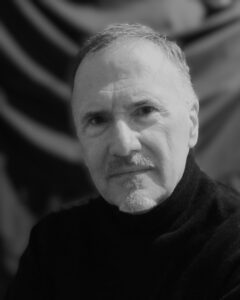
Dr Paul Foster

Paul studied piano, voice, conducting and composition at the University of London (Master of Music) and vocal studies at the London Guildhall School of Music and Drama.  He has a PhD in Music Composition from the University of Manchester and has been a visiting professor at the University of St Mark & St John.

He worked in London for many years in a wide range of music, covering music theatre, orchestral, symphonic wind orchestra and opera repertoire, and on projects with the Royal Opera House and London Sinfonietta, ranging from accompanying West End stars in recital to playing piano on the South Bank for the Sir Peter Maxwell Davies birthday celebrations. By contrast, his first experience of a recording studio was with Manfred Mann’s Earthband.

Returning to his native South-West, he has conducted almost one hundred performances at the Theatre Royal in Plymouth and has been conductor for award-winning performances with New Devon Opera and Plymouth G&S Theatre Company, holding the title of conductor emeritus with the latter.  He regularly guests for orchestras and choirs across the region as a continuo player in oratorios.

On the educational side of his career, Paul has been Music Advisor for the largest of the London boroughs, an Ofsted inspector (shh!) and has trained around five thousand new primary and secondary teachers to teach music as part of their initial teacher training.

As well as working as a composer, conductor, pianist and university lecturer, he is an award-winning actor and published poet.  He won a national award for his portrayal of the title role in ‘Amadeus’ in Greenwich – a version of Mozart’s persona that he does not seek to emulate when conducting that composer’s works!

Performances of Paul’s compositions have included the South Bank and abroad, and his works have been selected for the annual shortlist of the Society for the Promotion of New Music.  One of his latest pieces, a large-scale oratorio called ‘The Lodestone of Love’, was commissioned by Plymouth Philharmonic Choir for the Mayflower 400 celebrations, delayed due to Covid restrictions, but which will be premiered in the Guildhall sometime in the coming months.